The Art and Science of Sales - Making Money Online Without Selling Your Soul
 SAMX10-25-2026, 03:06 PM · 8 min read🔔Log in to subscribe2 subscribers
And honestly, I understand why.
We've all seen the ridiculous promises. The overnight millionaires. The people posing in front of rented sports cars. The courses teaching you how to sell courses to people who want to learn how to sell courses.
Good grief.
But after spending a few decades building websites, creating products, and doing business online, I've learned something.
There's absolutely nothing wrong with making money on the internet.
There's nothing wrong with getting paid for solving somebody else's problem.
The problem isn't selling. It's what some people are willing to do to make a sale.
I Still Think It's Pretty Incredible
When I first started building websites, the idea of making money online fascinated me.
Think about it.
You sit down at a computer with absolutely nothing but an idea.
No storefront. No warehouse. No inventory.
You write some words, create some graphics, put together some code, and eventually those little pixels become something another human being finds useful enough to pay you for.
Something you created out of practically nothing.
I still think that's pretty damn cool.
Especially back in the early days, when we were figuring everything out as we went along.
There weren't tutorials for every little problem. We experimented, broke things, fixed them, and spent ridiculous hours getting something to work.
And when somebody finally bought something you'd created?
Man, that was a feeling.
Not necessarily because of the money, either.
Somebody, somewhere, found value in something you made.
That meant something to me. Still does.
And no, I didn't become some internet millionaire. But I suppose that depends on your definition of rich.
I've made a perfectly comfortable living working from home, with the freedom to be there and help raise my family.
Personally, I consider that a pretty good return on my investment.
I've Always Had an Inventor's Mind
I've created, written, designed, and built all kinds of things over the years. Websites, digital products, tools, services, and a few ideas that probably should've stayed ideas.
I've always had a habit of hearing somebody describe a problem and immediately trying to figure out a solution.
Sometimes before they've even finished explaining it.
Ask Louie or Andy. They've both been on Zoom calls with me when I've gone completely off the rails chasing an idea.
One minute we're having a perfectly normal conversation, and the next I'm practically designing an entire business around something somebody mentioned in passing.
It's annoying, I'm sure.
I'm still not entirely convinced they don't think I'm insane, but they're both still talking to me, so I guess we're good.
Anyway, I've always enjoyed solving problems.
I'm also a people pleaser, sometimes to a fault, and a bit of a protector by nature. Ask my family. I have a habit of taking responsibility for things that aren't necessarily mine to worry about.
So when I figure out how to make somebody's life easier, I get a genuine sense of satisfaction from it.
And if somebody wants to pay me for that?
I don't see anything particularly evil about the arrangement.
Provided they receive something worthwhile.
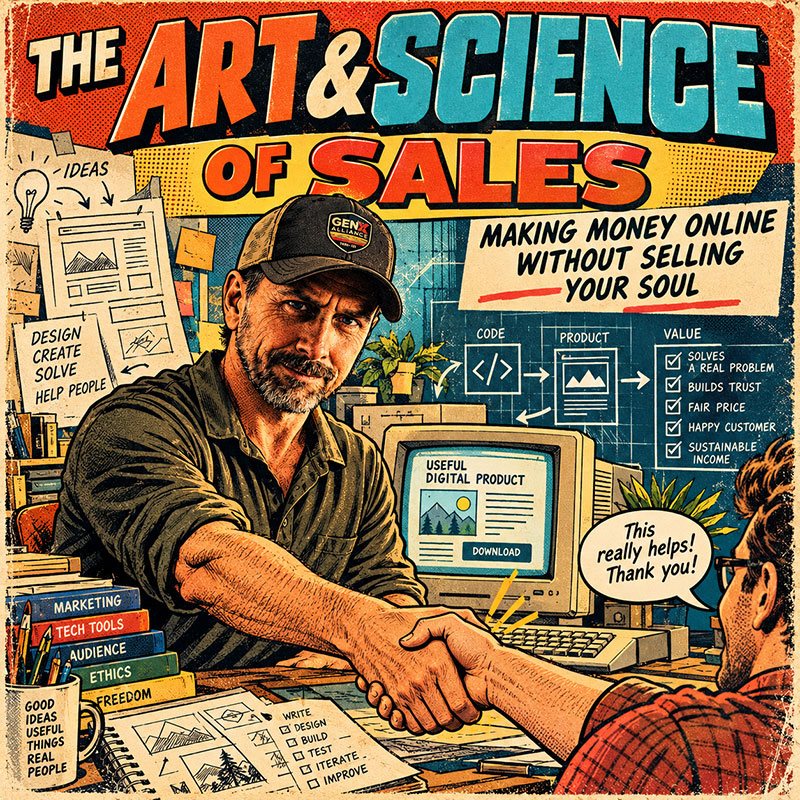
The Art and Science of Sales
I've always considered sales a combination of art and science.
The science is understanding the problem.
Who has it? What have they tried? What's frustrating them? What would make their lives easier?
The art is communicating your solution clearly enough for somebody to understand its value.
Good salesmanship isn't about convincing people to buy things they don't need.
It's about presenting something useful to people who might benefit from it, then letting them decide.
And sometimes the solution is good enough that it practically sells itself. People recognize the value without needing a twenty-minute pitch.
Of course, they still need to know it exists.
Here's where digital products become particularly interesting.
People sometimes ask why anybody would pay for a guide, tutorial, or template when the information is already available online for free.
Well, sure.
You can find instructions for fixing your plumbing, preparing your taxes, or changing your brakes, too.
Doesn't mean everybody wants to spend their Saturday doing those things.
Suppose you need to learn something.
You spend three hours searching, watching videos, sorting through conflicting advice, and figuring out which instructions are accurate.
Or somebody who's already done the work offers you a complete, organized, easy-to-follow solution for ten bucks.
Some people enjoy doing the research themselves. Others would gladly spend ten dollars to get those three hours back.
Neither person is wrong.
You're not necessarily selling secret information. You're providing organization, clarity, convenience, experience, and saved time.
There's legitimate value in that.
But the product still needs to deliver what you promise. A fancy cover and a convincing sales page won't make a lousy product worthwhile.
I've Learned a Few Things the Hard Way
Now, before anybody thinks I'm presenting myself as some ethical marketing expert who's always gotten everything right, let me clear something up.
I haven't.
Over the years, I've associated with people whose true character I didn't recognize until much later. Some were exceptionally convincing at presenting themselves as something they weren't.
I've also promoted things I later realized didn't meet the standards I should've expected.
I wasn't knowingly trying to mislead anybody, but ignorance doesn't erase responsibility.
Those experiences taught me some uncomfortable lessons.
And here's how I see mistakes.
Making a mistake because you didn't know better is one thing. Once you know better, continuing to make the same mistake is something else entirely.
At some point, you have to stop calling it ignorance and admit you're being an idiot.
Trust me, I've had a few opportunities to make that distinction.
My goal has always been to learn, improve, and find better ways of doing business. I haven't always succeeded, but I take those lessons seriously.
Because if somebody trusts you enough to spend their hard-earned money on something you recommend or create, you owe them an honest representation of what they're buying.
No fabricated reviews. No fake urgency. No ridiculous income promises.
And if your product isn't right for somebody, say so.
I don't believe honesty should be treated merely as a clever marketing strategy. It's how people deserve to be treated.
Besides, I'd much rather have somebody happy with a ten-dollar purchase than feel responsible for somebody regretting a hundred-dollar one.
You Don't Need Some Million-Dollar Idea
Here's another thing worth considering.
You don't have to invent something the world has never seen.
Sometimes a clearer explanation is enough. Sometimes a simpler tool is enough. Sometimes organizing a complicated process into something a complete beginner understands is enough.
A useful checklist, a practical guide, a spreadsheet, a template, or a small digital tool might solve a problem somebody deals with regularly.
And you don't necessarily have to possess every skill required to create it.
Maybe you're good at writing but terrible at design. Somebody else might be an excellent designer who struggles with writing.
Work together.
Some of the best opportunities come from people combining different abilities, respecting what each person contributes, and accomplishing something neither would've managed as easily alone.
That's one of the things I've always appreciated about the internet. It connects people with different skills and experiences.
Of course, none of this guarantees success.
I've spent plenty of time creating things that earned absolutely nothing.
Sometimes you'll invest money and lose it. Other times, especially with digital projects, your biggest investment is your time.
And time certainly has value. Don't underestimate that.
But not every unsuccessful project is a complete loss, either. You might walk away with new skills, useful experience, or something you eventually apply to a better idea.
The important part is keeping your risks reasonable, learning what people need, and testing your ideas before investing more than you're comfortable losing.
You don't have to build an empire.
You might simply create one useful thing.
Maybe We Need to Rethink What Selling Means
For all my complaints about what the internet has become, I still love the original idea behind it.
An ordinary person with a computer, some knowledge, and an idea has an opportunity to create something useful and offer it to other people.
Today's tools have removed many of the technical obstacles we dealt with years ago.
Of course, easier tools also mean more competition and more junk. But the ability to produce something quickly doesn't automatically make it worth buying.
Quality still matters. Honesty still matters. Experience and attention to detail still matter.
And I think more ordinary people ought to explore the possibilities.
Not because everybody's going to get rich.
Not because there's some secret system waiting to be found.
But because you might know how to solve a problem somebody else struggles with.
You might have years of knowledge another person would appreciate having explained in plain English.
You might have an idea for something that would save somebody time, effort, or frustration.
And you might enjoy creating it.
So pay attention to the problems people complain about. Think about the things you already know how to do. Consider whether you might turn some of that knowledge into something genuinely useful.
If you do, don't feel guilty about asking a fair price.
Your time has value. Your knowledge has value. And the time you save somebody else has value, too.
I've made my share of mistakes over the years, and I'm sure I'll make more.
But after all this time, I still get a kick out of turning an idea into something another person finds worthwhile.
I think we've let the scammers, hustlers, and professional bullshit artists convince too many decent people there's something wrong with making money online.
There isn't.
You don't have to sell your soul to sell something useful.
And you don't have to become a millionaire for the experience to be worthwhile.
Sometimes there's a lot of satisfaction in building something, helping somebody, and earning a few honest dollars along the way.
I'd like to see more of that on the internet again.
Sean (SAMX)
More from SAMX's Zine
 Building More Than a Website: A Year of Lessons, Changes, and PossibilitiesSAMX2 hours ago · 5 min read
 I Let AI Do My Writing. Then I Realized What It Was Costing Me.SAMX10-24-2026, 08:08 AM · 5 min read · 💬 5
 What Kind of Sick Individual Does This?SAMX10-19-2026, 08:52 PM · 2 min read · 💬 9
Written by a member of The GXA: GenX Forum.
A free online hangout for Generation X. Every member gets their own zine.
Join free
Comments 0
No comments yet. Go first.
Join free to comment or log in
This conversation on the forum